Sapporo Station had humble beginnings, as a small temporary station on a local railway that connected Hokkaido coal mines with a regional shipping port. But like Sapporo City itself, it steadily grew into Hokkaido’s transport and commercial hub.
Before 1868, Sapporo as a settlement was merely a spot on a plain less swampy or mountainous than the rest of Hokkaido. After that it began to grow, thanks to the provisional colonizing agency moving government buildings north from Hakodate to centralize Hokkaido’s defense and development. Foreign experts were also brought in to develop the prefecture’s agricultural economy, and with them engineers to lay out Sapporo on a grid (very unusual in Japanese cities).
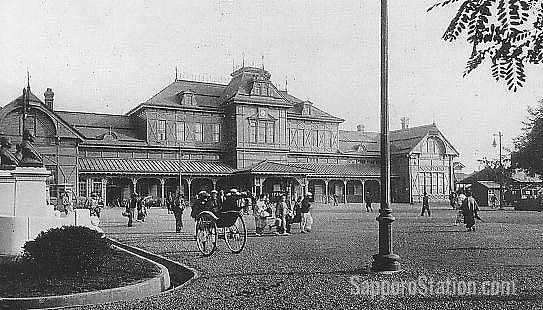
Sapporo Station in Taisho era (1912-1926)
Public transportation took a while longer to become a priority. Around 1880, as Sapporo was becoming an administrative ward, the Horonai Railway opened between Temiya and Sapporo to carry coal from inland mines to the port at Temiya, part of present-day Otaru. The first Sapporo Station was a small temporary stop, and a more substantial second station building followed in 1882 after construction began the previous year. A third station building was completed in 1908 after the previous wooden station had been heavily damaged by fire. Further improvements to its infrastructure and services followed in 1909, 1917, and 1930, adding places to eat as well as to wait.
By 1952, Sapporo Station had been transformed from a wooden to a concrete structure, and included its first local department store. By 1958, a second train line was added. By the 1960s, it had become a multistory structure surrounded by Sapporo’s budding financial district. By the 1970s, Sapporo Station was feeling the benefits of Hokkaido’s developing tourist economy, as air traffic between Chitose Airport, present-day New Chitose Airport, and Tokyo Haneda grew into one of the world’s busiest air routes. Sapporo’s once-centralized downtown began to develop a dumbbell shape, split between the major department stores by Odori Park and the rival merchants setting up shop four blocks away within and underneath Sapporo Station.
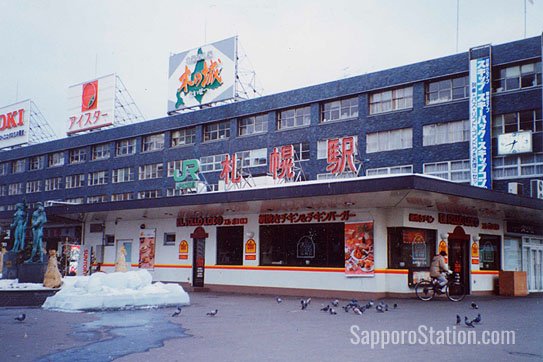
Sapporo Station building in 1990s (source Wikimedia:Yasu)
By 1988, Sapporo Station had expanded to 11 tracks and opened elevated tracks. By 2003, it had completely revamped itself into a skyline-dominating multistory complex, including JR Tower Hotel Nikko Sapporo, surrounded by high-rise competitor hotels and office buildings, with floor after floor of shopping areas and food emporiums. The Hokkaido Shinkansen opened between Shin-Aomori and Shin-Hakodate-Hokuto in 2016, and work is under way to extend the line from Shin-Hakodate-Hokuto to Sapporo. Official project materials place the expected completion and opening around the end of fiscal 2038, with the final date subject to construction risk, so Sapporo Station’s next major transformation is unfolding through long-term construction rather than a single imminent opening.
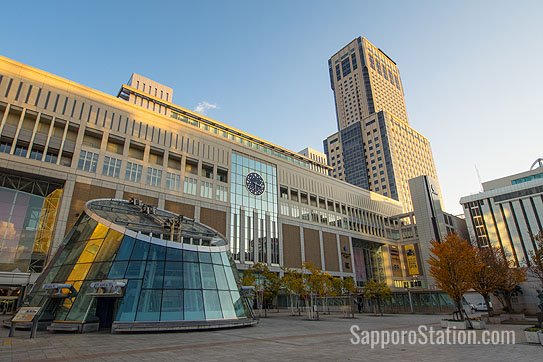
Sapporo Station today
JR Sapporo Station has become the one place that visitors to Sapporo could not (and should not) avoid. Not only because it is the transportation hub of the city and beyond, but also because it is a great place to walk around, shop, and explore. You will feel that you are in a major metropolitan area, with facilities on a scale commensurate with Hokkaido’s largest city and one of Japan’s biggest urban centers. Come see it for yourself.
Article by Dr. Debito Arudou. All rights reserved. Last updated 18-Aug-2026.