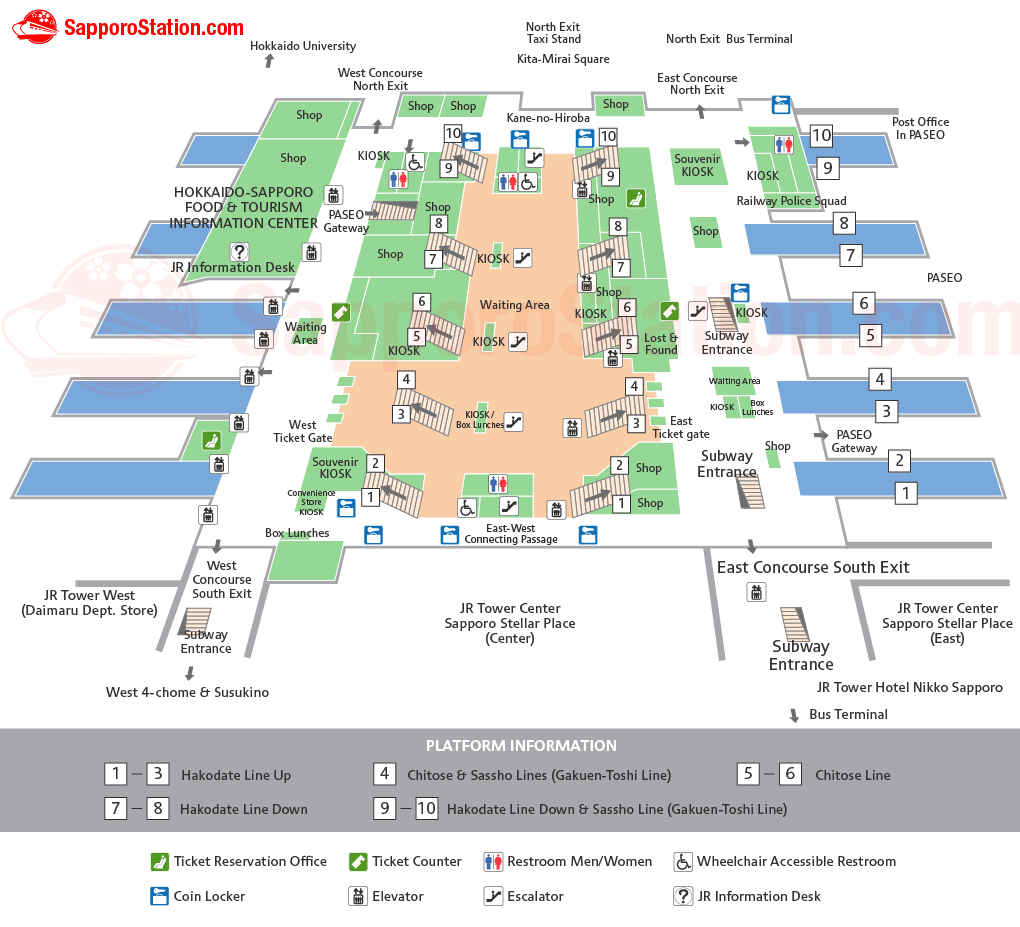
Japan’s major train stations can be confusing. For example, JR Tokyo, JR Shinjuku, and JR Ueno are enormous maze-arrays of trains, subways, escalators, shops, underground passageways, and constantly flowing crowds. Compared to them, JR Sapporo is usually easier to grasp. JR Tower opened in 2003 and gave the station its modern south-side landmark, and the station’s basic logic is simple: elevated rail platforms above, ticket gates and concourses below, and main exits to the north and south.
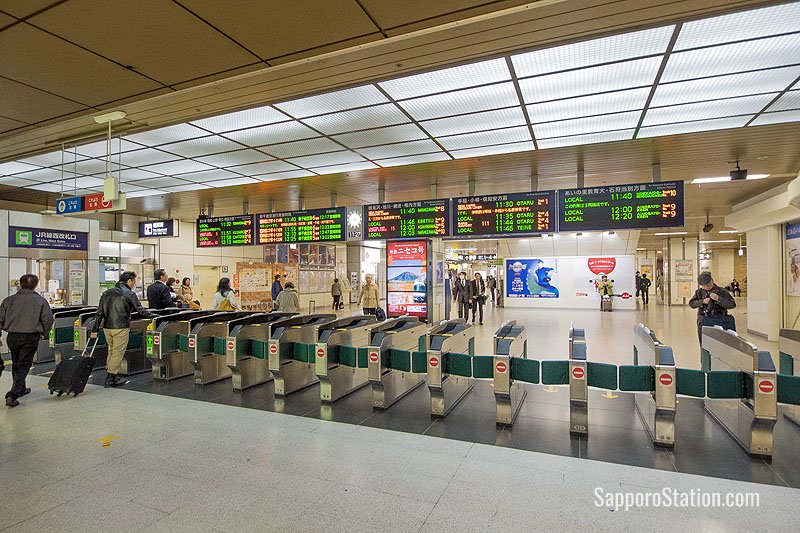
Sapporo Station East Ticket Gate
However, Hokkaido Shinkansen construction and station-area redevelopment can temporarily change the easiest route through parts of the station. Follow the posted signs in the concourse, especially around connections to JR Tower, the subway, and underground passages.
Coming from New Chitose Airport, you will disembark on an elevated platform with views of the city facing North and South. It’s a pleasant view, and a good preview of the city, but follow the crowds downstairs to the main floor. You’ll pass by kiosks, shops, and, if it’s wintertime, Sapporo denizens standing snugly around portable space heaters installed by the station. Winters in Hokkaido are quite cold, and JR Sapporo Station’s platforms are of course somewhat exposed to the elements. But not to worry. Keep walking: You’ll feel the station sharply warm up by degrees the closer you get to the exit ticket gates, which face East and West.
If you pass through the East Ticket Gate, you will come out on the East Concourse, close to routes toward Sapporo Stellar Place, JR Tower, the South Exit side, and connections toward the Toho Subway Line. If you pass through the West Ticket Gate, you will come out on the West Concourse, useful for the North Exit, South Exit, the Hokkaido-Sapporo information facilities, Apia, Daimaru, and several station-area hotels. In either case, look first for the North Exit or South Exit signs, then follow the shopping or subway signs from there.
If you are ready to take in tourist information, the Hokkaido-Sapporo “Food & Tourism” Information Center is in JR Sapporo Station’s west concourse by the North Exit. Inside are the Hokkaido-Sapporo Tourist Information Center, Hokkaido Dosanko Plaza, and the JR Information Desk for foreign visitors. This is a useful first stop for multilingual pamphlets, sightseeing advice, rail-pass and ticket help, and general Hokkaido travel information.
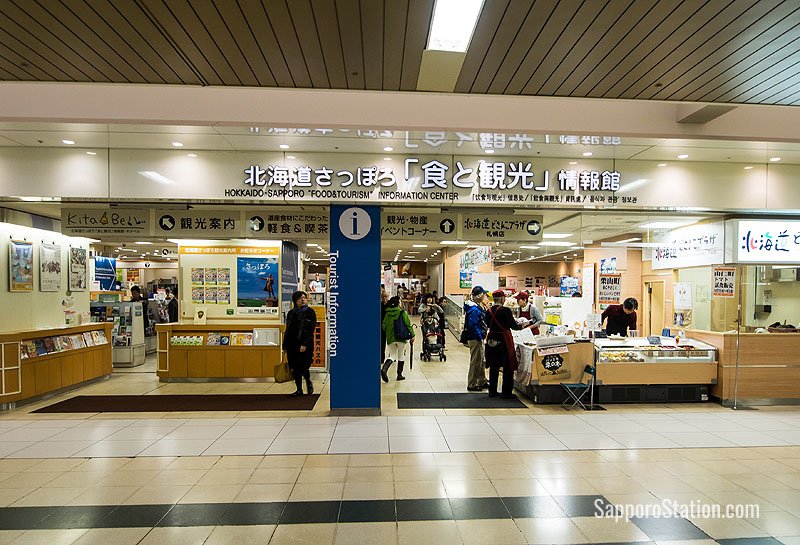
JR Information Desk and the Hokkaido-Sapporo Food & Tourism Information Center
Either ticket gate you choose, you’ll find yourself on the ground-level floor. Sapporo Station has essentially two exits to the outside: North and South. You can peek out of the North Exit to board a bus or walk toward the leafy campus of Hokkaido University, whose main gate is about 7-10 minutes away on foot from the north side of the station.
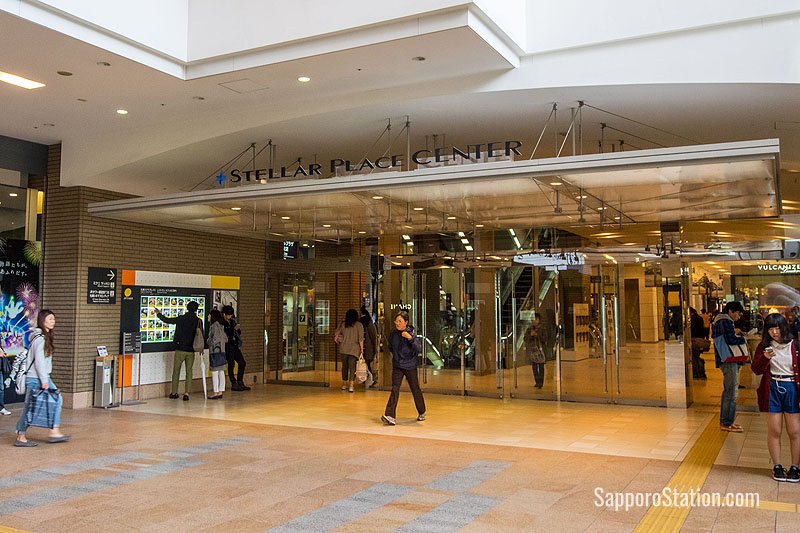
Stellar Place entrance from the East Concourse
Or you can step out of the South Exit, walk to the main street curb, and turn around for a clear view of JR Tower, Sapporo Stellar Place, and the south-side station plaza. Topped by the JR Tower Hotel, and surrounded by skyscrapers on all sides, the quad offers lovely night illumination all year-round.
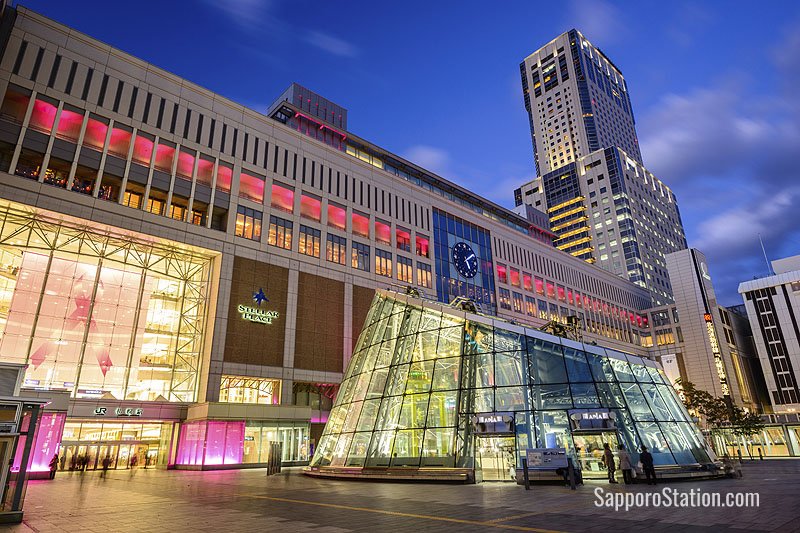
Exterior view of JR Sapporo from the South Exit
However, given Hokkaido’s six-month winters, most of the exciting stuff takes place indoors, so let’s return. Look up as you reenter the South Exit and you will see the open-air enclosed piazza of Stellar Place Sapporo, with multistory shopping hemmed in by balconies. We talk more about shopping around the station in a separate article, so loop around and follow the southbound crowds underground.
Popular Hotels near Sapporo Station




Walking down a cascade of short stairwells will bring you through underground malls and by the Sapporo Subway stop, offering access to many central areas within city limits. Walk farther south beyond the subway and you will reach the Sapporo Ekimae-dori Underground Walkway, usually called Chi-Ka-Ho, a 520-meter underground passage beneath Ekimae-dori linking the Sapporo and Odori stations on the Namboku Subway Line, close to Odori Park.
Opened in 2011, Chi-Ka-Ho offers climate-controlled comfort in defiance of Hokkaido’s long winters and takes about 10 minutes to walk from end to end. Around Odori, it connects with Sapporo’s underground shopping streets: Aurora Town extends east from Odori for 312 meters, while Pole Town extends south for 400 meters toward Susukino. Follow that route and you can continue underground toward Susukino, Sapporo’s party zone. If you are not in the mood to retrace your steps, then jump on the subway; it is only two stations back to JR Sapporo.
But JR Sapporo’s environs are not all people passing through. We have selected a number of noteworthy hotels within walking distance, and many are helped by the well-lit, clean, and spacious underground routes that start around JR Sapporo Station.
Again, JR Sapporo Station is relatively easy to navigate, thanks to Sapporo’s layout on a grid. The general rule of thumb is: Destinations are North-South, sights and shopping are East-West. Arrive at JR Sapporo Station, drop your bags, and explore Sapporo’s above- and below-ground world. Yes, you might temporarily get lost. But at least, cozily-nestled underground with everyone else, you’ll stay warm.
Article by Dr. Debito Arudou. All rights reserved. Last updated 20-Aug-2026.