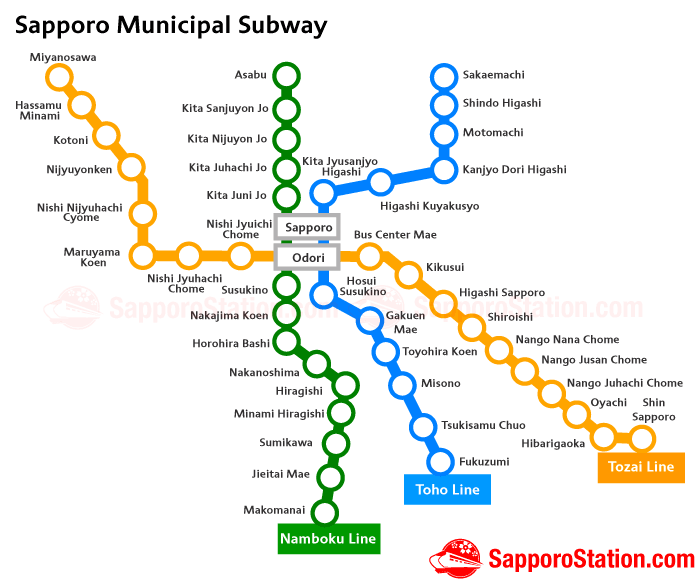
Sapporo Municipal Subway is a rapid transit railway network in Sapporo that is mostly located underground. It has three lines: the Namboku Line which runs north-to-south through the city and is color-coded green, the Tozai Line which runs east-to-west through the city and is color-coded orange, and the Toho Line which follows a more irregular north-south route on the city’s east side and is color-coded blue.
The Namboku and Toho Lines connect at Sapporo Station, while all three lines meet at Odori Station in the city center.
Sapporo Municipal Subway is fast, taking roughly 2 or 3 minutes to travel between stations, and it is open between 6:00 and 24:00. In this way it provides a swift and convenient means for traveling between the city center and some of its outlying attractions. It also connects with Sapporo’s bus and streetcar networks at various points and so helps provide easy access to all parts of the city.
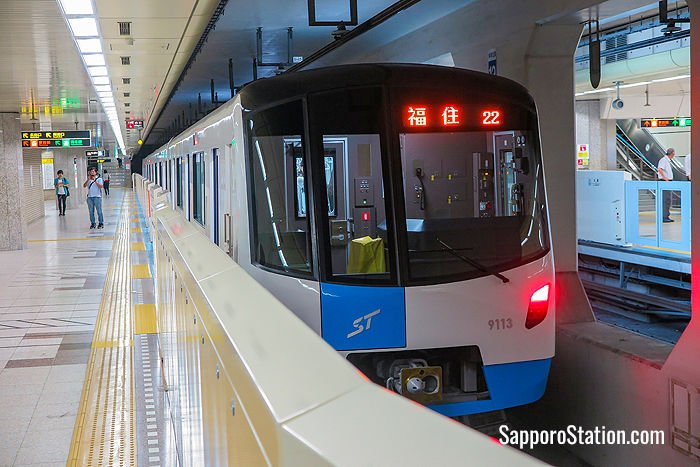
A train on the Toho Subway Line
The Namboku Subway Line
The Namboku Line runs between Asabu Station in the north of Sapporo and Makomanai Station in the south. This line links Sapporo Station with important locations in central Sapporo such as Odori Park and the Susukino entertainment district.
North of Sapporo Station, Kita-Juni-Jo Station is a convenient exit point for Hokkaido University’s Sapporo Campus and for Hokkaido University Museum.
On the southern part of the Namboku Line’s route Nakajima-Koen Station provides access to Nakajima Park and a historic wooden guesthouse called the Hoheikan. At the southern end of the line Makomanai Station provides access to Makomanai Park, and also to the Chuo Bus service for Sapporo Art Park.
For full details of this route and its key destinations see our Namboku Subway Line article.
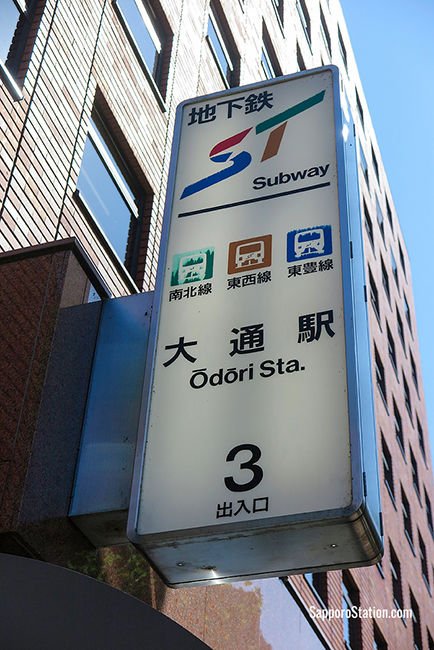
A sign at Entrance 3 of Odori Station
The Tozai Subway Line
The Tozai Line runs between Miyanosawa Station on the west side of Sapporo and Shin-Sapporo Station in the east. This line can be used to travel from Odori Station in the center of the city to attractions on the city’s outskirts such as Shiroi Koibito Park which is close to Miyanosawa Station or the Historical Village of Hokkaido which can be accessed by bus from Shin-Sapporo Station.
Other useful stops are Maruyama-Koen Station for Maruyama Zoo and Hokkaido Jingu Shrine, Nishi-Juhatchome Station for Hokkaido Museum of Modern Art, and Bus Center-Mae Station for Chitosetsuru Sake Museum.
For full details of this route and its key destinations see our Tozai Subway Line article.
The Toho Subway Line
The Toho Line runs between Sakaemachi Station in the north of the city and Fukuzumi Station in the south. Like the Namboku Line, this line can be used to travel between Sapporo Station and the Odori Park and Susukino areas.
The Toho Line is also useful during Sapporo Snow Festival years that include the Odori, Susukino and Tsudome sites, because it serves Odori, Hosui-Susukino and Sakaemachi. Other useful stops are Higashi-Kuyakusho-Mae Station for the Sapporo Beer Museum and Fukuzumi Station for Daiwa House PREMIST DOME, also widely known as Sapporo Dome.
For full details of this route and its key destinations see our Toho Subway Line article.
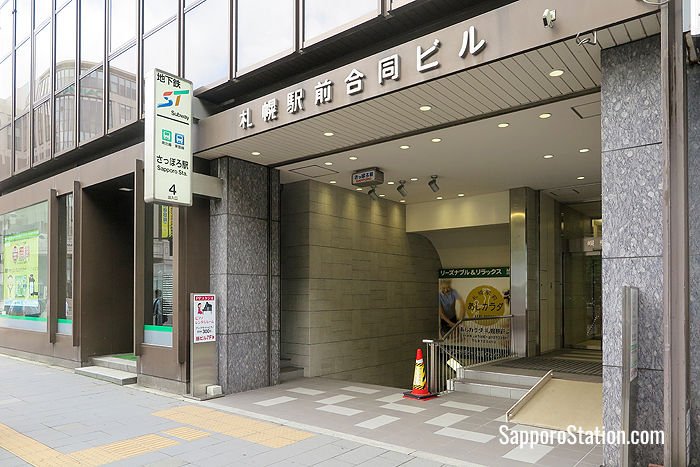
Entrance 4 for Sapporo Subway Station
Transfers
Sapporo Municipal Subway connects with JR rail services as well as the city’s streetcar and bus networks at several locations.
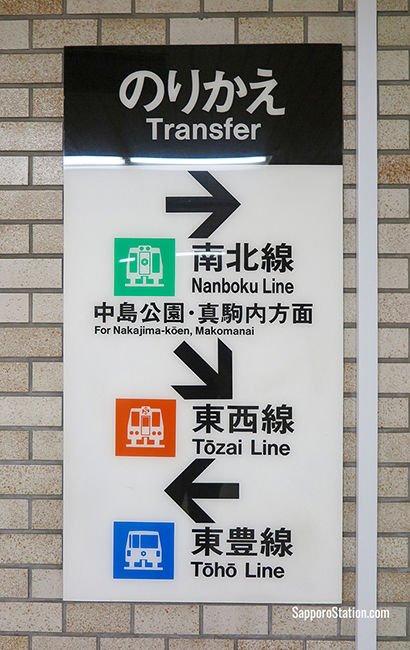
A transfer sign at Odori Station
Subway Transfers
Passengers can transfer between the Namboku and Toho lines at Sapporo Station, but this transfer requires leaving one set of gates and entering the other line’s gates within 30 minutes. If you are starting at Sapporo Station, enter through the gates for the line you intend to ride. At Odori Station, all three subway lines connect. Susukino Station on the Namboku Line is also just a 5 minute walk from Hosui-Susukino on the Toho Line.
JR Transfers
Sapporo Subway Station is directly connected to JR Sapporo Station by an underground passage. This provides access to the Hakodate Main Line, Gakuentoshi Line, and Chitose Line. Passengers can also transfer to the Chitose Line at Shin-Sapporo Station on the Tozai Subway Line.
Streetcar Transfers
Streetcar stops are located near several subway stations allowing for easy transfers between the two networks. Streetcar stops can be accessed from Susukino, Nakajima-Koen, and Horohira-Bashi stations on the Namboku Line. On the Tozai Line they can be accessed from Nishi-Juhatchome and Nishi-Juitchome stations. On the Toho Line the streetcar can be accessed from Hosui-Susukino Station. There is also a streetcar stop near Odori Station which is served by all three subway lines.
Bus Transfers
Sapporo Station remains a major bus hub, but the former Sapporo Station Bus Terminal is temporarily closed during redevelopment. City, highway and sightseeing buses use temporary stops around the station area, so check the operator or Sapporo City bus-stop map before transferring. Odori Bus Center also has some city and highway bus services and is located close to Bus Center-Mae Station on the Tozai Line.
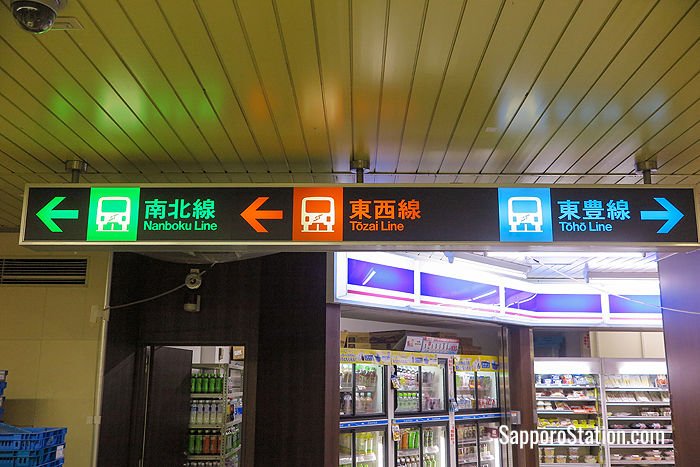
Subway line signs at Odori Station
Buying Tickets
Tickets are available from automatic ticket machines which are located beside the ticket gates at each subway station.
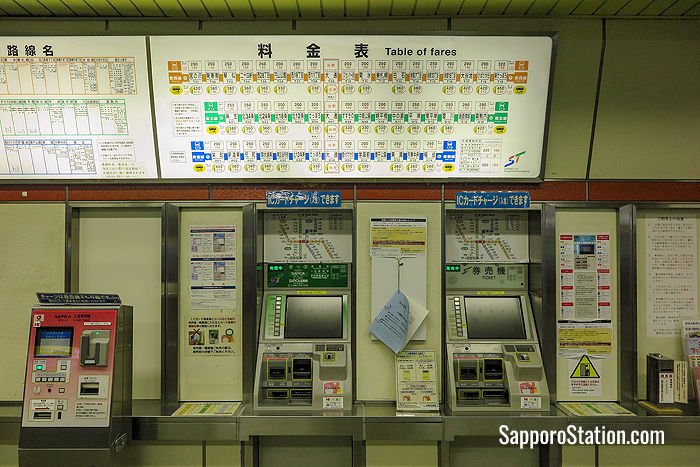
Sapporo Municipal Subway ticket machines
The ticket machines are operated by touch screens and have an English language option so they are quite easy to use.
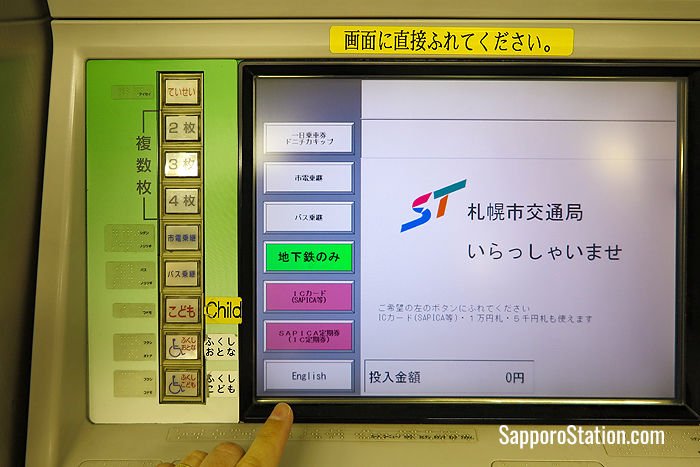
The English language button is located at the bottom of the screen
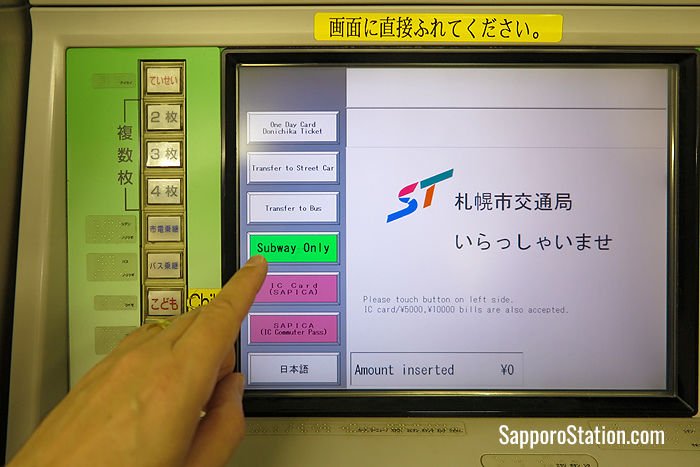
Choose the Subway Only button…
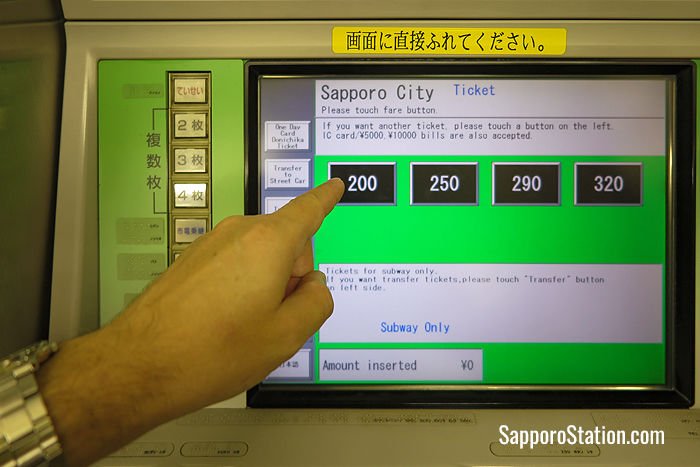
…then choose your ticket
There are also fare charts above the ticket machines which have destinations written in both Japanese and English.
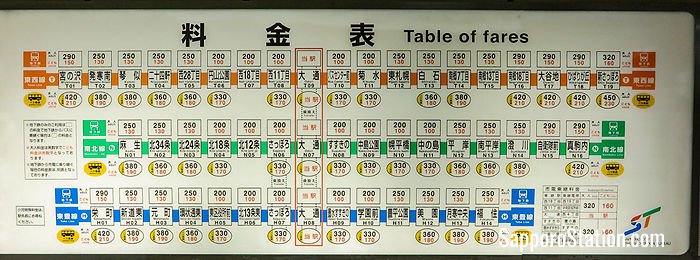
A fare chart above the ticket machines showing all subway destinations
Sapporo Municipal Subway fares range from 210 to 380 yen for adults and from 110 to 190 yen for children.
In addition to paper tickets and IC cards, Sapporo Municipal Subway accepts compatible contactless credit/debit cards and smartphone or wearable-device payments at dedicated readers on all three subway lines. This service is for adult ordinary fares; use tickets or IC cards when child fares, welfare discounts or transfer discounts are needed.
Discount Tickets
If you plan to use the subway system several times in one day, it is a good idea to buy a One Day Ticket. This allows one day of unlimited rides on the subway and costs only 830 yen for adults and 420 yen for children. There is also a cheaper one day pass called the Donichika Ticket which is available for use on Saturdays, Sundays, national holidays, and the year-end/New Year period from December 29 to January 3. This costs 520 yen for adults and 260 yen for children. These discount tickets can be bought from automatic ticket machines and commuter-pass offices, and are cash purchases. For adults using contactless payment on the subway, the daily fare cap automatically matches the 830-yen weekday one-day ticket or the 520-yen Donichika level on eligible days, provided the same card or device is used.
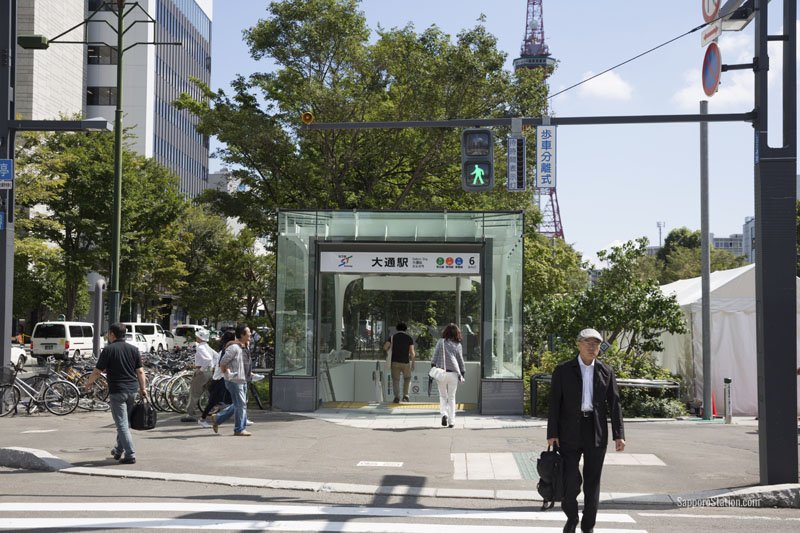
Odori Station entrance. This station is an interchange Namboku Line, Tozai Line, and Toho Line.
IC Cards
Prepaid IC cards can be used on Sapporo Municipal Subway. The local IC card is called SAPICA and this can be used on bus routes in the Sapporo area and the Sapporo Streetcar as well as on the subway. SAPICA earns points on subway, bus and streetcar fares, and when you have collected enough of these points you can use them to pay for your fares. Other IC cards do not earn SAPICA points. This card can also be used as electronic money at some shops in Sapporo and at vending machines that have the SAPICA logo.
The SAPICA card can be purchased and recharged at automatic ticket machines in Sapporo’s subway stations. However, SAPICA is a Sapporo-area card rather than a nationwide IC card, so most short-term visitors will find Kitaca, Suica, PASMO, ICOCA or another compatible nationwide card more flexible for travel outside the SAPICA area. Other IC cards that can be used both on Sapporo Municipal Subway and in other regions throughout Japan are Kitaca (JR Hokkaido), Suica (JR East), PASMO, manaca, TOICA, PiTaPa, ICOCA, Hayakaken, nimoca, and SUGOCA.
Useful Links
For official subway fares, one-day tickets and IC-card guidance, see Sapporo City Transportation’s English fare and tickets page. For route maps, station maps and transfer guidance, use the official Sapporo City Transportation route-map page. Sapporo City’s contactless-payment page has the latest details on credit/debit card tap payment and the daily fare cap.
Visit the official SAPICA website for details of how to use this IC card in Sapporo.
Article and original photos by Michael Lambe. All rights reserved. Last updated 18-Aug-2026.